Product links on this page go to Amazon. If you buy through them, Your First Kayak earns a commission. How we pick and earn
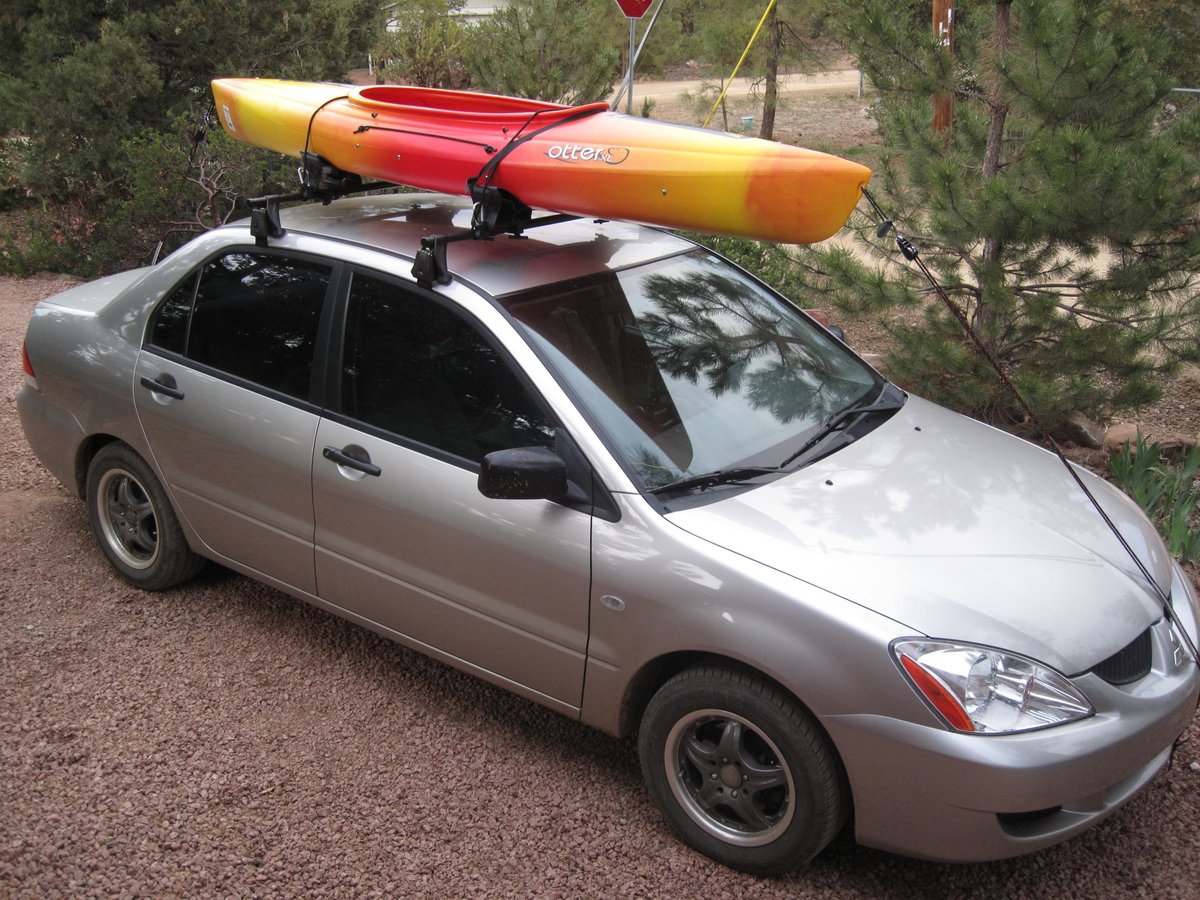
Most kayaks that never get used are stopped at the car. Here is how to get a boat onto a roof alone, keep it there at 70 mph, and not become one of the videos.
Lifting alone
For a boat under about 50 pounds: stand it on its stern beside the rear bumper, hull toward the car, lift the bow onto the rear crossbar or a towel on the trunk, then walk to the stern and push it forward. The hull slides; you never carry the whole weight at shoulder height. For heavier boats, a cart to the car and a second person at the roof, or a loading bar that pulls out from the rack.
No rack: foam blocks
Two foam blocks on a bare roof, two straps through the open doors over the boat, and bow and stern lines to the tow points: the Attwood kit is the whole thing. It works for one boat and a first season. Its limits: straps through the doors let in rain and squeak, loading takes longer, and the end lines are not optional, because there’s no rack to hold the boat if a strap slips.
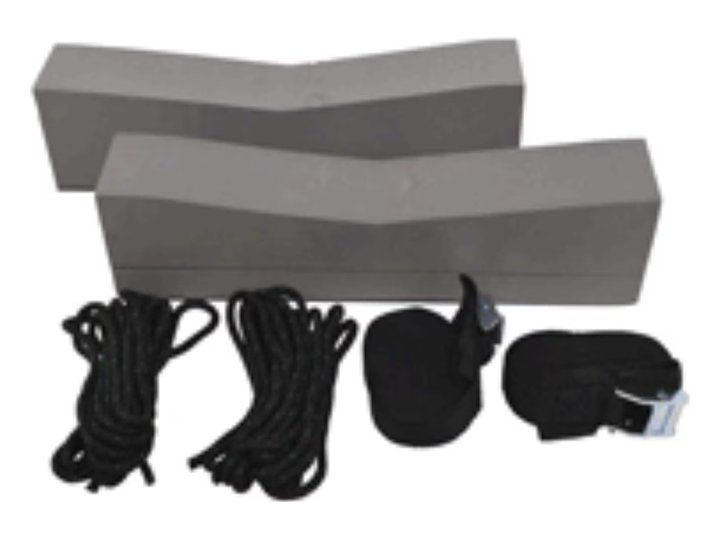
Foam blocks and straps, no roof rack
Attwood kayak carrier kit (no rack)
Attwood Universal Kayak Carrier Kit, no rack
Two angled foam blocks, two buckle straps and bow and stern lines: the way to carry one kayak on a car with no rack at all.
- Contents
- 2 angled foam blocks, 2 straps, bow/stern ropes (listing)
- Fits
- Bare roofs; one kayak
Suits: A first season before buying a rack, and a rental car.
Weigh: Attwood's site blocks readers, so the specs are the maker's listing. Blocks fit a bare roof only; the bow and stern lines are rope, so add the Thule hood loops. Slower to load than a cradle and not for highway speeds without the end lines.
Crossbars: cradle or saddle
With crossbars, a J-cradle stands the boat on its edge, which frees roof space for a second boat and puts the load on the hull’s strongest line. The Thule Hull-a-Port XTR comes with straps and tie-downs and folds flat; the Yakima JayLow is rated to 100 lb for a heavy fishing boat. Saddles carry the boat hull-down and are the easiest to load from behind; they take the whole roof.
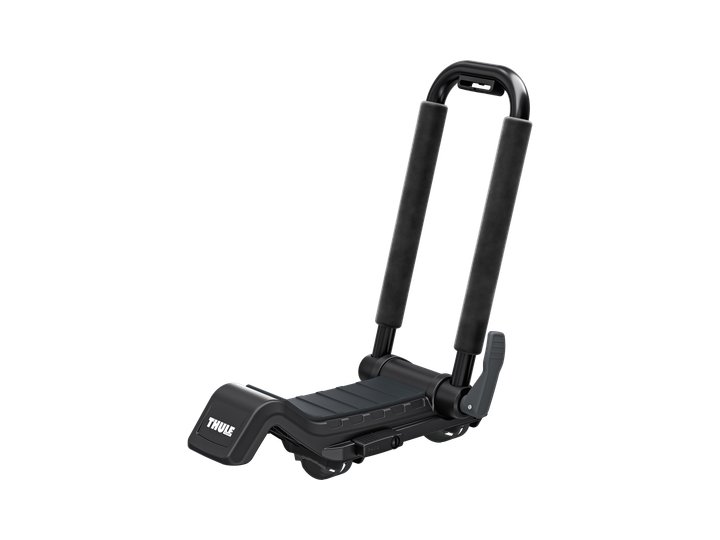
Folding J-cradle, 1 or 2 boats
Thule Hull-a-Port XTR
Thule Hull-a-Port XTR 848004
Thule's folding J-cradle: one kayak to 75 lb on its side, or two boats to 130 lb combined with the stacker position, straps and bow/stern tie-downs in the box, and it folds flat when empty.
- Capacity
- 1 boat to 75 lb, or 2 boats to 130 lb combined
- Weight
- 12.5 lb
- Size
- 20 × 9 × 20 in
- In the box
- 2 × 15 ft straps, buckle bumpers, bow/stern tie-downs
Suits: The rack for a car that already has crossbars.
Weigh: Needs crossbars. The older Hull-a-Port XT is superseded; this is the current model. Lock cylinders are extra.
Straps
Cam straps, not ratchets. NRS, which sells both, says the straps need only be snug enough to keep the boat from shifting, and that cranking down distorts plastic hulls and stresses the rack. One strap over the boat at each crossbar, buckle on top where you can reach it, tail tied off. A twist in the strap’s flat run stops the hum at speed.
Then the bow and stern lines, which NRS describes as anchoring the ends of the boat to the vehicle rather than the rack, and Pelican as tying both ends to bumpers or tow hitches. If a rack fails, the lines keep the boat with the car. Hood loops (Thule’s Quick Loops) give a car with no tow points something to tie to. NRS cam straps, a pair for the hull and a pair for the ends.
Overhang
A twelve-foot tandem on a short car hangs off the back. The federal rule for commercial vehicles (49 CFR 393.87) flags a load that extends more than four feet beyond the rear with a red or orange flag at least 18 inches square; passenger-car rules are state law and vary, but a red flag on the stern is cheap insurance everywhere.
At the launch
A cart for the walk from the lot. Straps off before the boat comes down, boat off the roof the way it went on, in reverse. Then the first launch.