Product links on this page go to Amazon. If you buy through them, Your First Kayak earns a commission. How we pick and earn
The boat is on the car, the paddle is the right length, the life jacket fits. Here’s the first day, in the order that works.
Pick the water
Flat, warm, with a beach or a gentle bank, no current and no boat traffic: a pond, a small lake, a protected cove. Not a river, not the ocean, not a reservoir on a windy afternoon. Check the water temperature, not the air; below 70 °F the cold water guide applies, and the first day should wait for warmer water or a sit-inside and a wetsuit.
The swim test
Before the boat goes in, you do. Wade in wearing the life jacket, float, swim ten strokes. The National Center for Cold Water Safety lists this among its five rules for a reason: you learn how the vest rides, whether it’s loose, and that it works, in conditions you chose. Tighten the straps until it doesn’t ride up when you pull on the shoulders.
Getting in
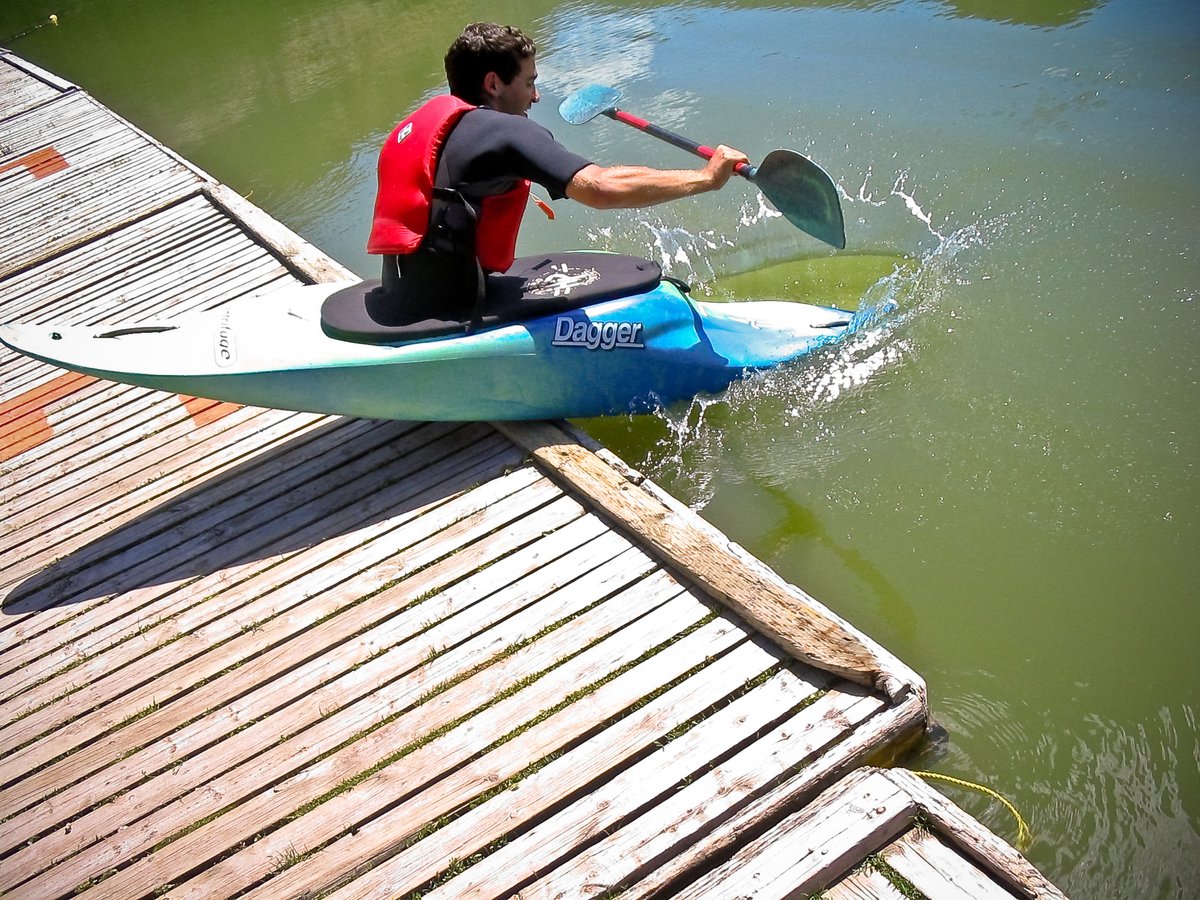
Sit-on-top: float the boat in knee-deep water, sit on it sideways like a bench, swing your legs in. Sit-inside: same depth, paddle across the cockpit behind you as a brace, sit on the back deck, slide your legs in, lower yourself. Both are easier in a foot of water than from a dock; docks come later.
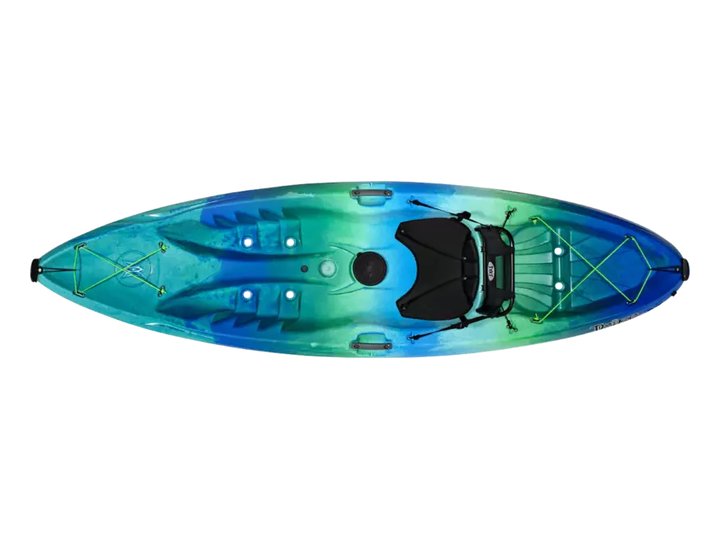
Sit-on-top, 9.5 ft, with a real seat
Perception Tribe 9.5
Perception Tribe 9.5
A US-made recreational sit-on-top with a high-back frame seat that reclines, a rear tankwell, and a hull that handles lakes, slow rivers and light surf.
- Length × width
- 113 × 31.5 in
- Weight
- 48.5 lb
- Capacity
- 300 lb
- Seat
- High-back frame seat, reclining
- Storage
- Rear tankwell with tie-downs
- Paddle
- Not included
- Made in
- USA
Suits: Someone who sat in a budget boat and hated the seat; coastal and bay beginners.
Weigh: No hatch, and heavier than the Pelican at 48.5 lb (Amazon says 46; Perception says 48.5). Stock on the listing was thin on the check date.
The first strokes
Forward stroke: blade in near your feet, pull back to your hip, out. Rotate your torso, don’t just pull with your arms; the paddle is a lever for your trunk. Short strokes, both sides, and the boat goes straight-ish. Sweep stroke: a wide arc from bow to stern on one side turns the boat the other way. Stop: blade flat in the water, both sides. That’s enough for a first hour.
Falling in, on purpose
In waist-deep water, tip the boat over. For a sit-on-top, flip it back upright, grab the far side, kick your legs to the surface and pull yourself across it belly-first, then turn and sit. Ten minutes of this and a capsize in deep water becomes a wet inconvenience. For a sit-inside, flip it, drain what you can, and practise the same belly-first re-entry with the pump within reach; in deep water this needs a paddle float, which is a lesson for the second month.
In the boat
- The life jacket, on, zipped.
- The whistle, on the vest.
- A dry bag with keys, phone, water and a snack, clipped to the boat.
- The pump and a sponge, for a sit-inside.
- Sun protection; the water doubles it.
- A light if you’ll be out near dusk, which is the rule as well as sense.
Tell someone
Where, when back, and what the boat looks like. The Coast Guard’s casualty numbers are mostly people alone on a calm day who didn’t expect to be in the water.
Then go again. The second day is when it becomes fun. The kayaks page has the boat, and the transport page the rest.