Product links on this page go to Amazon. If you buy through them, Your First Kayak earns a commission. How we pick and earn
The life jacket is the one piece of gear on this site that isn’t a preference. Here are the rule, the numbers behind it, and how to pick one you’ll wear.
The rule
Federal regulation 33 CFR 175.15: no one may use a recreational vessel unless there is at least one wearable life jacket on board for each person, used in accordance with its approval label, and no one may operate under way with a child under 13 aboard unless the child is wearing one (or is below decks, which doesn’t apply to a kayak). States may set their own child-wear age for their waters (33 CFR 175.25), and several do. Canoes and kayaks 16 feet and over are exempt from the extra throwable device (175.17); none of the boats here is that long.
“On board” is the legal minimum. The number below is why it isn’t enough.
The numbers
The Coast Guard’s 2024 Recreational Boating Statistics count 556 deaths across all boating. Where the cause was known, 76 percent drowned, and where life jacket use was known, 87 percent of those who drowned were not wearing one. For kayaks specifically: 89 deaths, 77 of them drownings. Canoes, kayaks and paddleboards together were the third-ranked vessel type for casualties.
A life jacket in the hatch is the one that wasn’t worn. Buy one you’ll keep on.
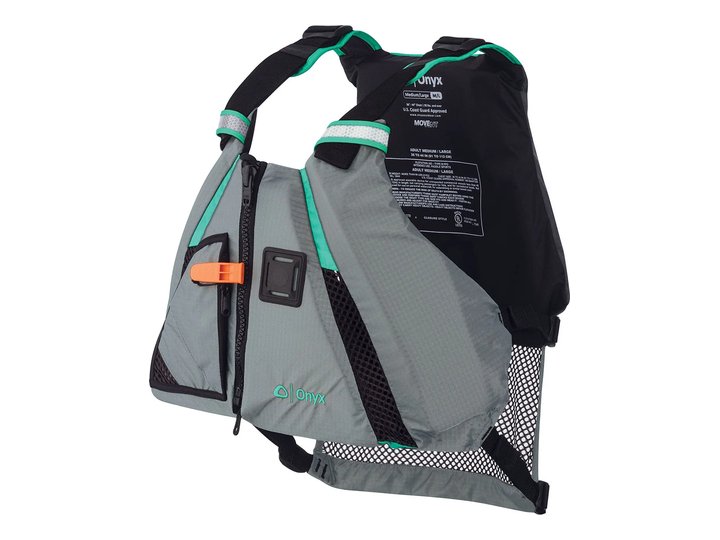
Paddling life jacket, mesh back
Onyx MoveVent Dynamic
Onyx MoveVent Dynamic
The paddling vest most beginners end up in: a low mesh back that clears a kayak seat, mesh ventilation front and back, a zip pocket, reflective trim, and a whistle on a lanyard, US Coast Guard approved.
- Approval
- US Coast Guard approved (maker)
- Fit
- Mesh lower back for kayak seats
- Sizes
- XS/S 28–36 in; M/L 36–44; XL/2XL 44–56 (listing)
- Extras
- Zip pocket, SOLAS reflective, whistle
- Shell
- Nylon ripstop
Suits: Anyone in a sit-on-top or sit-inside; the life jacket you will keep on because it doesn't fight the seat.
Weigh: Onyx doesn't publish the buoyancy or the Type/Level on the product page; the label does. Sizes run XS/S 28–36 in, M/L 36–44, XL/2XL 44–56 (listing chart), all for 90 lb and over. This listing is M/L; other sizes are separate listings.
Cold water
The thing beginners don’t know: cold water kills faster than cold air, and it does it in the first minute. The National Center for Cold Water Safety reports that breathing control starts to be affected below 77 °F, and sets its outdoor safety threshold at 70 °F, seven degrees below that. Its figures: you are twice as likely to die in a boating incident in water below 70 °F, and three times as likely between 50 and 60 °F, which is where cold-shock symptoms reach their maximum intensity for someone not acclimated. Its five rules are plain: wear your life jacket, dress for the water temperature, field-test your gear, swim-test your gear, and plan for the worst.
In practice: a lake in Florida in July is 85 °F; a lake in Michigan in May is 50. Same boat, same paddler, different risk by a factor of three. A sit-inside and clothes that work wet (no cotton) are the spring answer; staying ashore is a fine one too.
Choosing a paddling vest
Any Coast Guard approved vest satisfies the law. A paddling vest is cut so you’ll keep it on:
- A thin or mesh lower back, so the seat doesn’t push the vest up under your ears. Every vest on the paddles and life jackets page has one.
- Sized by chest. The one-size vests (Onyx) span 28 to 56 inches in three sizes; Stohlquist and Astral grade them properly. Measure, don’t guess.
- Flotation and type. Adult paddling vests are Type III (the newer labels say Level 70) with 15 to 17 lb of flotation; makers who publish it are NRS and Astral. Onyx and Stohlquist leave it to the label.
- A whistle on it. The rule asks every small vessel to carry a sound signal (33 CFR 83.33); the Onyx comes with one, otherwise a Fox 40 on the lanyard.
- Kids by weight, not age. A child’s vest with a collar and grab handle, 30–50 lb; infant under 30 lb is a Type II that turns a face up.
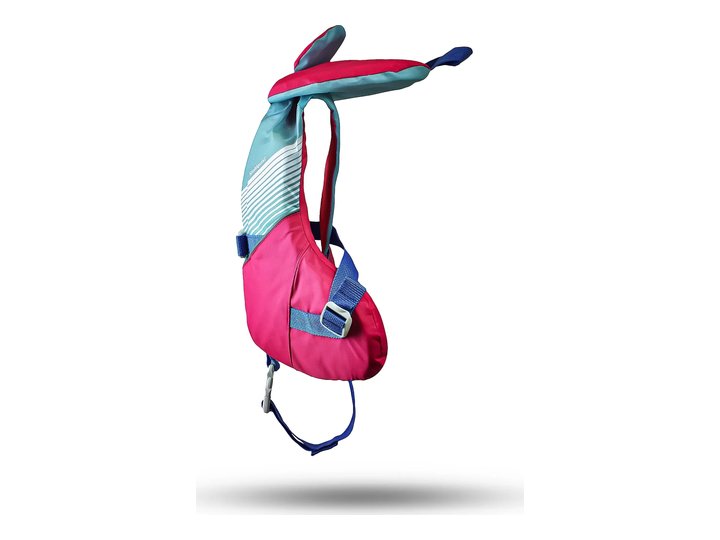
Child's life jacket, collar and grab handle
Stohlquist Child life jacket (30–50 lb)
Stohlquist Child
A child's vest with a flotation collar, a grab handle and a crotch strap so it stays on, for children of 30 to 50 pounds, USCG Type III.
- Approval
- USCG Type III
- Child weight
- 30–50 lb
- Features
- Flotation collar, grab handle, crotch strap
Suits: The passenger in the centre seat. Federal rules require children under 13 to wear one on a moving boat.
Weigh: Sized by weight, not age; a child over 50 lb needs the youth size. The infant version (under 30 lb) is a Type II with a face-up collar, a separate listing.
Then the paddle, and the first launch, which starts with a swim test of exactly this vest.