Product links on this page go to Amazon. If you buy through them, Your First Kayak earns a commission. How we pick and earn
The kayak aisle is forty boats that look alike. The questions that choose between them aren’t on any of the boxes, so here they are.
Three questions
- Where will you paddle? A lake or slow river wants stability and a short, light boat. A bay or beach wants a hull that handles chop and drains itself. Cold water, spring and fall, wants a sit-inside and a pump.
- How will you carry it? One person lifts about 45 pounds onto a roof. Two people lift 80. A closet and a trunk mean an inflatable.
- Who’s coming? Solo, a partner, a child, a dog. A tandem is one boat and two people at the rack; two singles are two purchases and no arguments.
The four kinds
Sit-on-top. You sit above the waterline on a sealed hull with drain holes. Pelican’s own guide says most newcomers feel more secure in one, it’s easier to climb back on after a capsize, and the drawback is the lack of dry storage. You will get wet. The beginner default for lakes, bays, beaches and fishing.
Sit-inside. You sit below the waterline in a cockpit. Pelican again: that makes the boat faster and easier to paddle. It’s drier and warmer, and a swamped cockpit needs a pump and a practised re-entry. The boat for cool weather and longer paddles.
Inflatable. Twenty-five to fifty pounds in a bag. The cheap ones (Intex) are low-pressure PVC that flex and wander in wind; the ribbed ones (Advanced Elements) hold a keel line and track like a hard boat. All of them take time to dry.
Tandem. Twelve to fourteen feet, 75 to 80 pounds, two seats and often a centre position for paddling it alone. Capacity 450 to 550 lb.
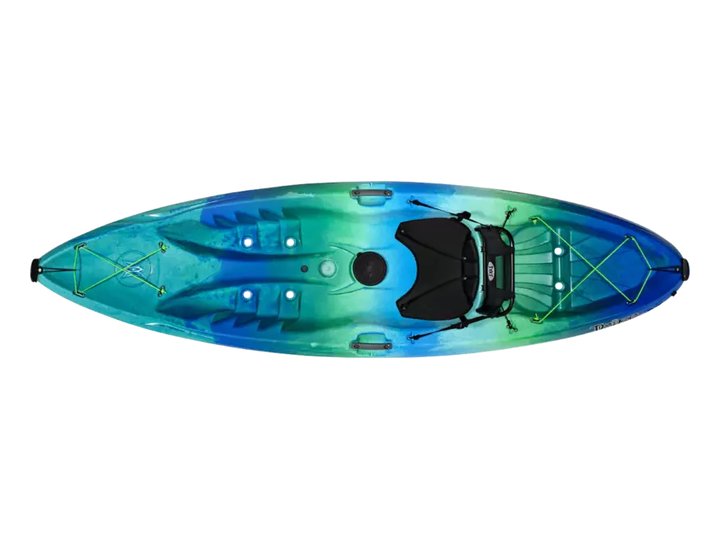
Sit-on-top, 9.5 ft, with a real seat
Perception Tribe 9.5
Perception Tribe 9.5
A US-made recreational sit-on-top with a high-back frame seat that reclines, a rear tankwell, and a hull that handles lakes, slow rivers and light surf.
- Length × width
- 113 × 31.5 in
- Weight
- 48.5 lb
- Capacity
- 300 lb
- Seat
- High-back frame seat, reclining
- Storage
- Rear tankwell with tie-downs
- Paddle
- Not included
- Made in
- USA
Suits: Someone who sat in a budget boat and hated the seat; coastal and bay beginners.
Weigh: No hatch, and heavier than the Pelican at 48.5 lb (Amazon says 46; Perception says 48.5). Stock on the listing was thin on the check date.
The numbers on the sticker
Length and width. Longer is faster and tracks straighter; wider is steadier and slower. Pelican puts it plainly: shorter boats are broader to make up the surface area, which makes them a little harder to paddle, and at ten feet the hull can narrow and still float you. Ten feet is the sweet spot for a first boat; eight feet is for small paddlers and small cars.
Weight. The number that decides whether you go paddling on a Tuesday evening. Pelican’s Ram-X boats run 36 to 57 lb; Lifetime and Old Town 50 to 78. Over 50 lb, plan on a cart or a partner.
Capacity. The most the hull will float: you, your gear, and the boat itself. Eddyline, one of the few makers to say so, puts the comfortable load at about 60 to 70 percent of the maximum. A 275 lb boat suits a 190 lb paddler with a bag, not a 250 lb paddler with a cooler. Pelican and Old Town publish only the maximum.
Hull material. Rotomolded or blow-molded polyethylene is what every hard boat here is; Pelican’s Ram-X is a multi-layer thermoformed version with a UV layer that flexes instead of denting. Inflatables are PVC; the better ones add a drop-stitch floor. All of it hates a summer of sun on the lawn; store it in the shade.
Six situations, one boat each
| You | Kind | Boat |
|---|---|---|
| A lake, loading alone | Light sit-on-top | Pelican Sentinel 100X, 44 lb |
| The beach or a bay | Surf sit-on-top | Ocean Kayak Malibu 9.5 |
| Staying dry, cool weather | Sit-inside | Pelican Argo 100X EXO, 36 lb |
| No garage | Inflatable | Intex Excursion Pro, or the AdvancedFrame |
| Fishing | Fishing sit-on-top | Pelican Catch Classic 100 |
| Two plus a kid | Tandem | Perception Rambler 13.5 T |
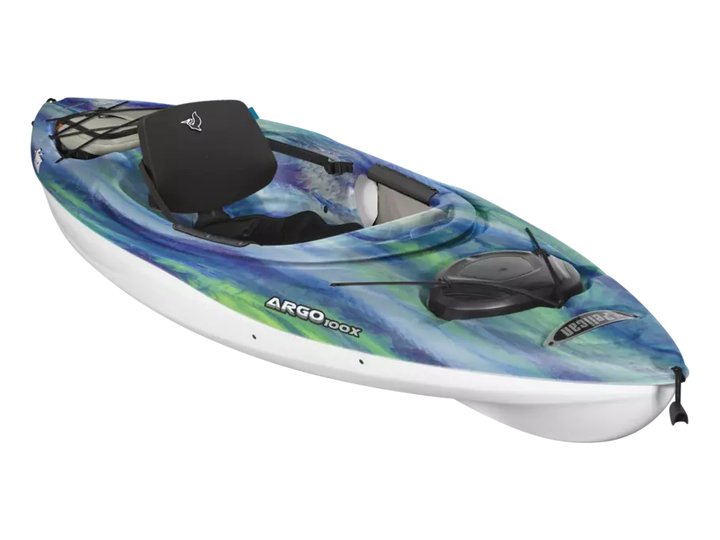
Sit-inside, 10 ft, 36 lb
Pelican Argo 100X EXO
Pelican Argo 100X EXO
The lightest ten-foot sit-inside here at 36 pounds: a twin-arched hull that feels planted, a padded adjustable backrest, a front hatch, and a 17-litre cooler compartment strapped in the rear well.
- Length × width
- 120 × 28 in
- Weight
- 36 lb
- Capacity
- 275 lb
- Hull
- Ram-X polyethylene, twin-arched multi-chine
- Seat
- Ergobreeze padded, adjustable backrest; molded footrests
- Storage
- Front hatch; ExoChill 17 L compartment
- Paddle
- Not included
Suits: Small and medium paddlers who car-top alone and want to stay dry.
Weigh: 275 lb capacity and molded footrests. The plain Argo 100X ships in one to two months on Amazon; this EXO version ships in days.
What every boat needs
A paddle sized to you and the boat (the chart), a life jacket cut for a kayak seat (and the rule), a whistle, and a way onto the car (the car guide). Then the first launch.
Every boat above is on the kayaks page.